Do you ever have a routine that looks great on paper but somehow feels disconnected, mechanical, or difficult to stick with? Maybe you have the right systems in place, but you’re moving through them like a checklist instead of feeling genuinely engaged with what you’re doing.
The structure of your routine matters, but structure alone isn’t always enough to create lasting change. When your habits start to feel hollow or you’re struggling to stay consistent, the missing piece may not be more discipline or a better system—it may be meaning. The way you experience what you’re doing can make all the difference.
In this episode, Lisa explores the powerful difference between routines and rituals and why you need both to create habits and systems that actually work for you. She explains how routines provide the structure and consistency needed to build habits, while rituals add intention, meaning, and personal connection to the things you’re already doing. You’ll hear how small sensory cues, intentional transitions, and meaningful details can transform an ordinary routine into something you genuinely want to return to.
Lisa also shares a real-life example of helping a client create a writing ritual, along with the personal rituals she uses for journaling and recording the podcast. You’ll discover how to build rituals into routines you already have without adding unnecessary complexity, spending money, or starting over. The goal isn’t to create a perfect ritual—it’s to make what you’re already doing feel more intentional, personal, and sustainable.
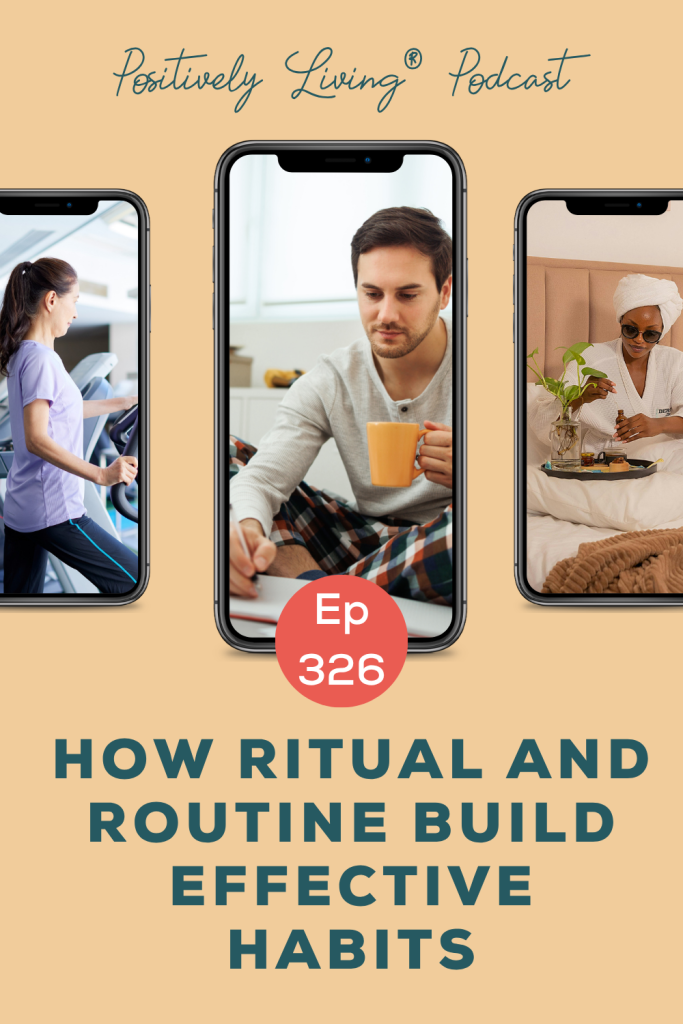
This week, episode 326 of the Positively Living® Podcast explores the difference between rituals and routines and shares how adding meaning, mindfulness, and personalized cues to your existing habits can help you create systems that feel more like you.
How Ritual and Routine Build Effective Habits
Have you ever created a routine that looks perfect on paper… only to find yourself struggling to actually stick with it?
Maybe you have a morning routine you’re determined to follow.
A weekly planning session you’ve carefully scheduled.
A journaling practice you know is good for you.
Or a creative project you’ve been meaning to make time for.
The structure is there.
But somehow, it still feels mechanical.
You go through the motions, check the boxes, and get things done—but you don’t necessarily feel connected to what you’re doing.
What if the problem isn’t that you need more discipline?
What if you’re simply missing the meaning that makes a routine feel like yours?
When Routines Start to Feel Mechanical
A routine is incredibly useful.
It’s a sequence of actions you do consistently. It gives your day structure, reduces decision fatigue, and helps you build the habits that create the changes you’re looking for.
Wake up.
Make coffee.
Check the calendar.
Walk the dog.
Sit down to work.
Close out the day.
These routines create the architecture of a productive life. They give you something reliable to return to, especially when you’re tired, overwhelmed, or having a difficult day.
But routines can sometimes become so focused on what you’re doing that you lose connection with why you’re doing it.
You might be productive without feeling satisfied.
You might check everything off your list without feeling particularly engaged.
You might even wonder why you’re having trouble continuing something that you know matters to you.
That’s where ritual comes in.
Routine vs. Ritual
A routine is defined by what you do.
A ritual is defined by how and why you do it.
Ritual adds intention and personal meaning to an existing routine. It transforms something mechanical into something that feels more connected to you.
As Lisa explains in this episode, routine without ritual can feel hollow. But ritual without routine may not stick.
You need both.
The routine provides the structure.
The ritual provides the meaning.
Together, they create habits and systems that are not only effective but sustainable and personal.
You Don’t Need to Start From Zero
Here’s the encouraging news:
You don’t need to create an entirely new practice to experience the benefits of ritual.
You simply need to change your relationship with something you’re already doing.
Lisa shares the example of a client who wanted to write a book. She already had dedicated time in her schedule for writing, so the routine existed.
But after a full day of work, she would sit down at her desk and struggle to transition into creative mode.
The problem wasn’t discipline.
It wasn’t even time.
She needed a signal that told her brain:
This is different. This matters. I’m ready.
So instead of creating a new schedule, they created a ritual around the routine she already had.
She made a specific tea.
She played instrumental music.
She shut down equipment she didn’t need.
She lit a favorite candle.
She put away materials related to her daytime work.
She read a sentence or two from a book she loved to help her transition into the language of creativity.
Then she took a deep breath and opened her writing documents.
The time slot hadn’t changed.
But her experience had.
The ritual created a bridge between the rest of her day and the creative work she wanted to do.
Ritual Creates a Transition
One of the most powerful things a ritual can do is help you shift from one state to another.
Think about how often you move through your day without a clear transition.
You finish one task and immediately start another.
You go from meetings to focused work.
You go from work to family time.
You go from scrolling to sleeping.
You go from a busy day straight into journaling, exercising, or another activity you want to prioritize.
Your brain doesn’t always automatically know that the context has changed.
A ritual gives it a cue.
A particular song.
A favorite drink.
A candle.
A specific workspace.
A certain notebook.
Different lighting.
Even a favorite tool.
These sensory details can help you become more present and signal that it’s time to shift into something different.
The Power of Sensory Cues
Your senses can become powerful anchors for your rituals.
Maybe you use a specific essential oil before journaling.
Maybe you play the same playlist before working on a creative project.
Maybe you have a favorite mug you use when planning your week.
Maybe you turn on a particular light when it’s time to record.
The cue doesn’t need to be complicated.
It simply needs to mean something to you.
Lisa explains that sensory cues can help your brain recognize what’s happening before you’ve consciously decided to make the shift. That’s part of what makes them so effective.
The goal isn’t to create elaborate conditions for productivity.
It’s to create a small moment that says:
It’s time to be here.
Add Intention Before You Begin
Another important part of ritual is intention.
Before jumping into your routine, pause for a moment.
Take a breath.
Ask yourself:
Why am I doing this?
Your answer doesn’t need to be profound.
Maybe you’re journaling because you want to understand yourself better.
Maybe you’re exercising because you want to feel stronger.
Maybe you’re writing because you want to bring an idea into the world.
Maybe you’re planning because you want your week to feel less chaotic.
Maybe you’re doing the work because it matters to you.
The point is to move from automatic to aware.
Instead of simply thinking, “I have to get this done,” you’re reminding yourself why you chose to do it in the first place.
That small shift can change the experience completely.
Keep Your Ritual Simple
Here’s where it’s easy to go too far.
You don’t need a 12-step morning ritual.
You don’t need a perfectly curated workspace.
You don’t need to buy a dozen new products.
And you definitely don’t need perfect conditions.
A ritual that requires too many steps or too much preparation will often collapse when life gets busy.
Instead, make it small enough to repeat.
Choose one sensory cue.
Add one intentional moment.
Use one favorite tool.
Take one deep breath.
That’s enough.
The ritual should support your routine—not become another routine you have to maintain perfectly.
Let Your Favorite Things Work for You
Sometimes the tools you use can become part of your ritual simply because you enjoy them.
Lisa talks about how certain tools she loves—including her Rocketbook, headphones, podcast microphone, and even an “on air” sign—have become part of her work rituals.
These objects aren’t just functional.
They help create a transition.
When Lisa puts on her headphones, closes the door, and turns on the light, she’s creating a visual and physical signal that it’s time to move from other business activities into recording.
The functionality matters.
But so does the feeling.
The right tools can make an activity more enjoyable, connect it to your personal values, and help you feel more engaged with the work you’re doing.
And you don’t necessarily need to buy anything new.
Look around at what you already love using.
Your favorite pen.
Your favorite playlist.
Your favorite notebook.
Your favorite chair.
Your favorite cup.
Those things can become meaningful parts of your rituals simply because they make the experience feel more like you.
Make Your Productivity More Personal
So often, productivity advice tells us what we should do.
Wake up earlier.
Use this system.
Follow this routine.
Track this habit.
Plan your day this way.
But effective productivity isn’t about copying someone else’s system perfectly.
It’s about understanding how you work.
That’s why rituals can be so powerful.
They allow you to personalize the structure you’ve already created.
Instead of asking:
“What should I be doing?”
You can also ask:
“How do I want this experience to feel?”
Then look for small ways to create that feeling.
Maybe you want your morning routine to feel peaceful.
Maybe your creative routine should feel playful.
Maybe your planning routine should feel calming and grounding.
Maybe your work routine should help you feel focused and confident.
The ritual becomes the bridge between the structure of the routine and the experience you want to have.
Start With One Routine
You don’t need to rethink your entire life.
Start with one routine you already have.
It could be:
Your morning routine.
Your end-of-day wind-down.
Your weekly planning session.
Your workout.
Your journaling practice.
Your creative time.
Then ask:
What would make this feel more like mine?
What could help you become more present?
What sensory cue could signal the transition?
What tool do you genuinely enjoy using?
What environment helps you feel connected?
What intention could remind you why this matters?
The answers to those questions are where your ritual lives.
Final Thoughts
You don’t need more structure just for the sake of structure.
And you don’t need to completely reinvent the routines you’ve already built.
Sometimes, the missing piece is meaning.
Your routine gives you the structure to keep going.
Your ritual gives you a reason to stay connected to it.
Together, they create habits that can be both effective and sustainable.
So take one routine you already have and make it a little more personal.
Light the candle.
Play the music.
Reach for the favorite notebook.
Take a breath.
Remember why you’re doing it.
And give yourself permission to actually be in the experience—not just move through it.
Because routines may help you get where you want to go.
But rituals are what make them yours.
If you’re looking for more ways to build sustainable productivity systems that fit your life, visit positivelyproductive.com/resources for tools and resources from Lisa, or explore the Positively Living® Podcast for more conversations about habits, productivity, simplicity, and creating systems that help you do less, live more, and breathe easier.
Thank you for listening! If you enjoyed this episode, take a screenshot of the episode to post in your stories and tag me! And don’t forget to follow, rate, and review the podcast and tell me your key takeaways!
Learn more about Positively LivingⓇ and Lisa at https://positivelyproductive.com/podcast/
Stop trying to fit into someone else’s productivity rules! Grab my free Productivity Toolkit, a collection of workbooks designed to help you explore how you work, uncover what truly matters to you, and create your very own energy-friendly systems. Get it here: www.positivelyproductive.com/plpkit
CONNECT WITH LISA ZAWROTNY:
LINKS MENTIONED IN THIS EPISODE:
Episode 241: How Being Cozy Helps You Be More Productive
Positively Living® Podcast Habits Playlist
Favorite Office Supplies & Tools
Positively Productive Resources Library
(Find links to books/gear on the Positively Productive Resources Page.)
Dance Song Playlist V1, V2, V3
Music by Ian and Jeff Zawrotny
Start your own podcast with Buzzsprout!