Have you ever noticed that a routine that worked perfectly a few months ago suddenly stops working? Or wondered why certain times of the year feel productive and energized while others leave you struggling just to keep up?
Many of us try to create one ideal schedule that will work all year long, but life doesn’t operate that way. Our energy, responsibilities, capacity, and priorities naturally shift throughout the year and throughout different stages of life. Instead of forcing ourselves into a rigid routine, what if we created schedules that worked with our seasons instead of against them?
In this episode, Lisa explores how to build a seasonal schedule that reflects both your season of life and the rhythms of the calendar year. She shares a practical framework for assessing your capacity, identifying recurring patterns, and creating flexible schedules that adapt to changing demands while supporting sustainable productivity.
This week, episode 320 of the Positively Living® Podcast explores how to create your best seasonal schedule and shares a step-by-step approach to planning around your energy, capacity, and real-life responsibilities.
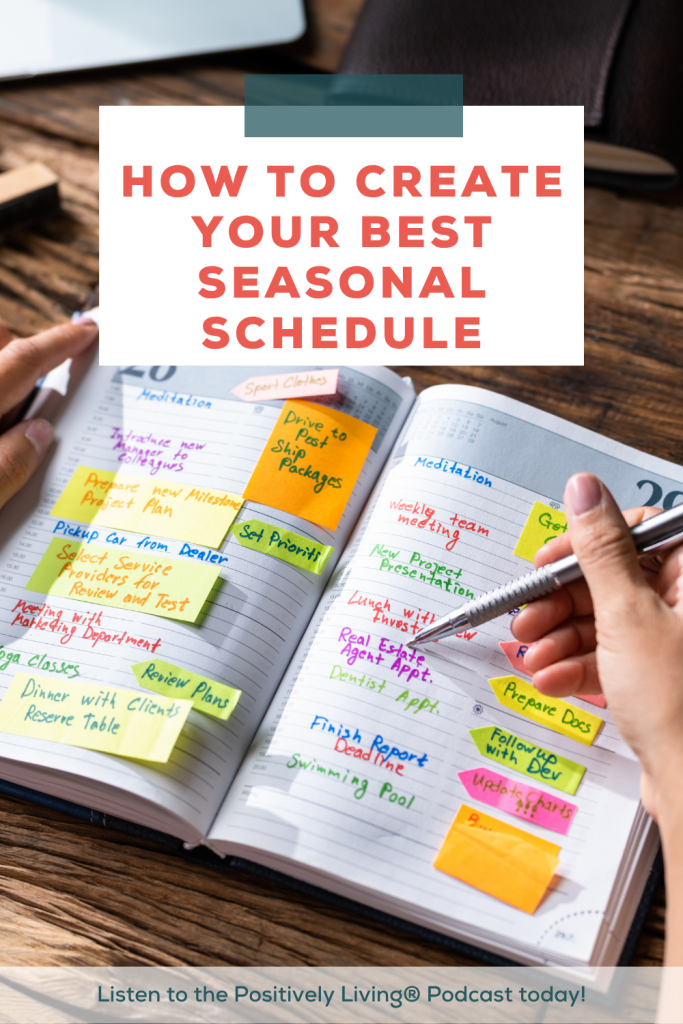
How to Create Your Best Seasonal Schedule
Have you ever created a routine that worked beautifully for a few months, only to watch it completely unravel when the season changed? Maybe your schedule feels manageable in the fall but chaotic in the summer. Or perhaps you find yourself overwhelmed every December despite promising yourself that this year will be different.
Many of us spend a lot of time searching for the perfect schedule, the ideal planner, or the ultimate productivity system that will work all year long. But the reality is that life isn’t static. Our energy, responsibilities, priorities, and capacity change throughout the year and throughout different seasons of life.
What if the problem isn’t your schedule?
What if the problem is expecting one schedule to work for every season?
Creating a seasonal schedule allows you to work with your natural rhythms instead of constantly fighting against them. Rather than forcing yourself into a rigid routine, you can build systems that flex with your changing needs while still providing the structure and consistency you crave.
Understanding the Two Types of Seasons
When we think about seasons, we often think about the calendar year: spring, summer, fall, and winter.
But there is another type of season that impacts your schedule just as much, if not more.
Your season of life.
Your season of life reflects what’s happening in your world right now. You may be raising young children, caring for aging parents, growing a business, navigating a career transition, recovering from burnout, or enjoying a season of greater stability and freedom.
These life seasons dramatically influence your available time, energy, and capacity.
A summer schedule looks very different for a parent managing school-aged children than it does for an empty nester. The holiday season feels different when you’re caregiving than when your responsibilities are lighter. A new business launch requires a different approach than a maintenance phase in your career.
The most effective schedules take both types of seasons into account.
Why One Schedule Doesn’t Work All Year
One of the biggest mistakes people make is trying to create a single routine that works in every circumstance.
The schedule that feels effortless in September may become completely unrealistic in December. The habits that fit neatly into your life during a slower season may feel impossible during a period of transition or increased responsibility.
This often leads to frustration and self-criticism.
We assume we’ve failed because we can’t maintain the same routine year-round.
In reality, the schedule may simply no longer fit the season.
Sustainable productivity requires adaptability. The goal is not to maintain the exact same schedule forever. The goal is to create systems that evolve alongside your life.
Step 1: Assess Your Current Season of Life
Before opening your calendar, take a step back and evaluate where you are right now.
Ask yourself:
- What phase of life am I currently in?
- What responsibilities consistently require my attention?
- What demands on my time are non-negotiable?
- Has my life changed recently in ways my schedule hasn’t accounted for?
- What does my current capacity feel like?
Your answers create the foundation for every scheduling decision that follows.
Capacity isn’t simply about available time. It also includes emotional energy, mental bandwidth, physical energy, and the demands you’re carrying behind the scenes.
A schedule that ignores these realities will always feel difficult to maintain.
Step 2: Identify Your Seasonal Rhythms
Once you’ve identified your current life season, it’s time to look at the year as a whole.
Every year contains natural cycles.
For some people, September feels like a fresh start filled with structure and momentum. Others thrive in the slower pace of summer. Some experience heightened stress during the holidays, while others find that season energizing.
Many parents experience intense periods during back-to-school season, end-of-year activities, or what some jokingly call “Maycember”—the hectic stretch filled with recitals, sports events, graduations, field trips, and countless commitments.
Business owners may experience seasonal rhythms tied to launches, client demand, or industry-specific busy seasons.
The goal is to identify your patterns.
Ask yourself:
- When do I typically feel most energized?
- When do I feel overwhelmed or stretched too thin?
- What recurring events impact my schedule every year?
- Which seasons do I consistently underestimate?
- Where do I need more support or flexibility?
Awareness creates the opportunity for better planning.
Step 3: Match Your Tasks to Your Capacity
One of the most effective ways to reduce overwhelm is to align your responsibilities with your available capacity.
Not every season is designed for major launches, ambitious goals, or significant life changes.
Some seasons are naturally suited for growth and expansion.
Others are better for maintenance, recovery, and simplification.
When planning your year, consider:
- Which projects require your highest energy?
- When are you most creative and focused?
- Which seasons require more rest and flexibility?
- What responsibilities can be reduced or postponed during demanding periods?
This approach allows you to work with your energy rather than constantly pushing against it.
Instead of wondering why everything feels harder than it should, you begin creating plans that reflect reality.
Step 4: Build Seasonal Versions of Your Schedule
Rather than searching for one perfect schedule, create multiple versions that align with different seasons.
Think of them as seasonal templates.
Some elements may remain consistent year-round:
- Core work hours
- Essential self-care practices
- Family priorities
- Key responsibilities
Other elements can flex depending on the season:
- Passion projects
- Volunteer commitments
- Exercise routines
- Creative work
- Personal goals
The goal isn’t inconsistency.
It’s intentional adaptation.
You are creating a framework that allows you to remain productive while honoring your changing capacity.
The Importance of Regular Reviews
A seasonal schedule is not a one-time project.
Life changes.
Children grow older. Careers evolve. Health fluctuates. Responsibilities shift.
What worked last year may not work this year.
Regular reviews allow you to make small adjustments before problems become overwhelming.
At the start of each season, consider asking:
- What’s working well right now?
- What feels difficult or unsustainable?
- What has changed since my last review?
- What support do I need in this season?
- What can I simplify?
Even a brief seasonal check-in can help you stay aligned with your current reality.
When Life Feels Too Overwhelming to Plan
Sometimes life throws unexpected challenges your way.
Major transitions, caregiving demands, health concerns, grief, and other difficult experiences can make long-term planning feel impossible.
In those seasons, it may be necessary to scale back your planning horizon.
Instead of planning an entire season, focus on the next day or the next week.
Simplify.
Prioritize only what truly matters.
Give yourself permission to adjust expectations.
The most productive thing you can do during overwhelming seasons is often to reduce complexity, not add more systems.
Productivity should support your life, not create additional pressure.
Final Thoughts
Creating your best seasonal schedule isn’t about becoming more disciplined or finding the perfect planner.
It’s about recognizing that your life naturally changes and allowing your systems to change with it.
When you understand your seasons, identify your rhythms, and plan around your actual capacity, you create a schedule that feels supportive rather than restrictive.
You stop forcing yourself to fit into a system that no longer serves you and start building one that reflects who you are right now.
Because sustainable productivity isn’t about doing the same thing all year long.
It’s about creating systems that grow and adapt alongside you.
If you’d like support identifying your current season and building a schedule that works with your life instead of against it, explore coaching opportunities at positivelyproductive.com/coaching.
Thank you for listening! If you enjoyed this episode, take a screenshot of the episode to post in your stories and tag me! And don’t forget to follow, rate, and review the podcast and tell me your key takeaways!
Learn more about Positively LivingⓇ and Lisa at https://positivelyproductive.com/podcast/
Stop trying to fit into someone else’s productivity rules! Grab my free Productivity Toolkit, a collection of workbooks designed to help you explore how you work, uncover what truly matters to you, and create your very own energy-friendly systems. Get it here: www.positivelyproductive.com/plpkit
CONNECT WITH LISA ZAWROTNY:
LINKS MENTIONED IN THIS EPISODE:
Episode 119: How Productivity is Impacted by Seasonal Energy
Episode 306: Planning a Day That Works for You
On-demand training for the Minimum Effective Day technique
(Find links to books/gear on the Positively Productive Resources Page.)
Dance Song Playlist V1, V2, V3
Music by Ian and Jeff Zawrotny
Start your own podcast with Buzzsprout!