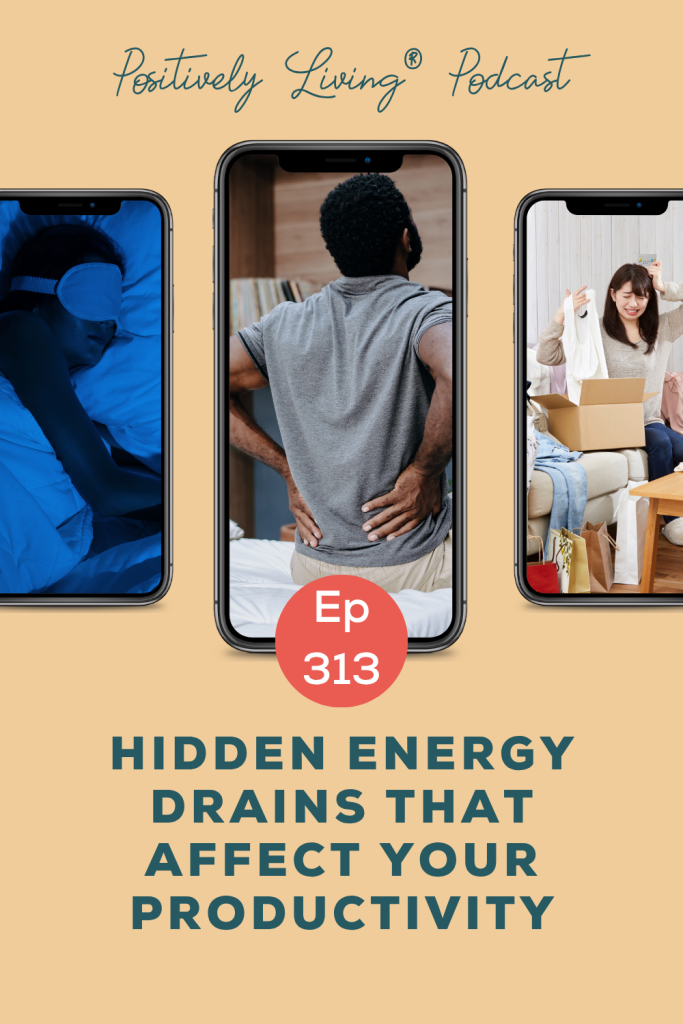
Have you ever sat down to work with everything you needed, yet still couldn’t get anything done? While we often blame a lack of motivation or discipline, productivity stalls are frequently caused by hidden energy leaks rather than a lack of willpower. Energy is the true currency of productivity, and several specific factors can drain it in ways you might not even realize are connected to your output.
This week, episode 313 of the Positively Living® Podcast explores five critical factors that have a direct, measurable impact on your focus and ability to finish your tasks.
Beyond Motivation: Identifying the Leaks Draining Your Productivity
You sit down to work. You have every tool you need, a clear plan, and a set of deadlines. Yet, you cannot seem to get anything done. When productivity stalls, most people assume they lack motivation or discipline. They believe they are not “enough” of something—focused enough, hard-working enough, or trying hard enough.
This narrative is often wrong. Energy is the real currency of productivity, and several hidden factors can drain that currency without you ever realizing it. If your output is suffering, it is time to stop blaming your willpower and start looking for the energy leaks.
The Biological Cost of Sleep Deprivation
Sleep is not a reward for finishing your work; it is a biological requirement for your brain to function at all. While you sleep, your brain clears metabolic waste and restores cognitive resources. Losing just one or two hours a night significantly impairs your attention and decision-making.
The danger of sleep deprivation is that we lose the ability to judge just how impaired we really are. Research shows that after 17 to 19 hours of wakefulness, your cognitive performance is equivalent to a blood alcohol level of 0.05%. You would not try to work while legally impaired, yet many people wear a lack of sleep as a badge of honor.
Key Takeaways:
- Recognize that sleep is a non-negotiable biological requirement for brain function.
- Understand that even mild sleep loss impairs decision-making and memory.
- Accept that your brain cannot accurately assess its own impairment when tired.
- Stop viewing sleep as a luxury you earn after finishing a to-do list.
Fueling the High-Energy Brain
Your brain consumes roughly 20% of your body’s total energy, despite it only making up about 2% of your mass. It literally runs on glucose. When you skip meals or rely solely on caffeine, you create blood sugar spikes and crashes that directly impact your focus and mood. These crashes lead to slower reaction times and increased irritability.
Key Takeaways:
- Fuel your brain consistently to maintain focus and cognitive capacity.
- Avoid blood sugar crashes that follow high-sugar meals or long stretches without food.
- Watch for irritability and decreased attention as signals of poor fueling.
- Ensure your nutrition strategy supports your specific cognitive needs.
The Hormonal Productivity Variable
Hormones affect your energy, mood, and executive function, yet they are rarely mentioned in productivity advice. Estrogen plays a role in regulating serotonin and dopamine, which are critical for motivation. Fluctuations during the menstrual cycle or perimenopause can lead to brain fog and fatigue that habits alone cannot fix.
Chronic stress keeps your primary stress hormone, cortisol, elevated. This impairs the prefrontal cortex—the part of the brain responsible for planning and decision-making. Even subclinical thyroid issues can manifest as “laziness” or burnout when they are actually medical energy drains.
Key Takeaways:
- Acknowledge that hormones like estrogen and cortisol directly impact executive function.
- Identify if brain fog or fatigue aligns with hormonal shifts or chronic stress.
- Realize that stress-induced cortisol elevation impairs your ability to plan and focus.
- Consult a professional if your energy does not respond to standard productivity habits.
The Background Drain of Health and Environment
Visual clutter in your workspace is more than just a mess; it competes for your attention. Every item in your field of vision that does not belong there adds a small but real cognitive load to your brain. Similarly, your physical health can act like a background app on a phone that silently drains the battery.
The immune system’s response to illness—even after visible symptoms disappear—draws heavily on your energy resources. Chronic pain and inflammation consume significant “attentional resources,” leaving you with less power for complex thinking. Pushing through an illness often leads to re-injury or prolonged fatigue because the body has not reached homeostasis.
Key Takeaways:
- Clear your workspace to reduce the visual competition for your attention.
- Account for the background energy drain caused by chronic pain or inflammation.
- Allow for sufficient recovery time after an illness to restore the body’s energy baseline.
- Open a window to improve air quality, as elevated CO2 levels significantly impair decision-making.
Final Thoughts You do not need to address every energy leak at once. Pick the one that resonates most with your current situation. One client found that focusing specifically on decluttering her drawers and folders created a domino effect that helped her prioritize her entire to-do list.
When you understand what is actually draining your battery, you can build systems that accommodate your real life. Your energy is worth protecting.
Next Steps to Restore Your Output:
- Identify: Which of the five areas (sleep, nutrition, hormones, environment, or health) feels like your biggest current drain?
- Audit: For one week, track your energy levels and look for patterns related to that specific drain.
- Adjust: Make one small change, such as clearing your desk or going to bed 30 minutes earlier.
Consult: If you suspect a medical or hormonal issue, book a conversation with your doctor to rule out subclinical causes.
Learn more about Positively LivingⓇ and Lisa at https://positivelyproductive.com/podcast/
Stop trying to fit into someone else’s productivity rules! Grab my free Productivity Toolkit, a collection of workbooks designed to help you explore how you work, uncover what truly matters to you, and create your very own energy-friendly systems. Get it here: www.positivelyproductive.com/plpkit
CONNECT WITH LISA ZAWROTNY:
LINKS AND RESOURCES MENTIONED IN THIS EPISODE:
Books Mentioned Amazon
Glucose Research
Prefrontal Cortex Research
Menstrual Cycle Research
Environment Research
PTSD Research
Ep 312: Why Your Energy is More Important Than Your Time
Ep 249: Five Energizing Habits to Make You More Productive
Ep 243: How Your Home Office Makes You More Productive
Decluttering Playlist
(Find links to books/gear on the Positively Productive Resources Page.)
Dance Song Playlist V1, V2, V3
Music by Ian and Jeff Zawrotny
Start your own podcast with Buzzsprout!