Have you ever found yourself caught in a mental loop? You’re circling a decision, replaying every possible “what if,” and rethinking your strategy for the tenth time…yet you haven’t actually moved an inch forward.
If you are a self-proclaimed overthinker or overanalyzer, you know this feeling all too well. You want to be responsible. You want to make the “right” choice. You want to feel 100% clear before you commit. But instead of achieving clarity, you find yourself stuck in the exhausting cycle of analysis paralysis.
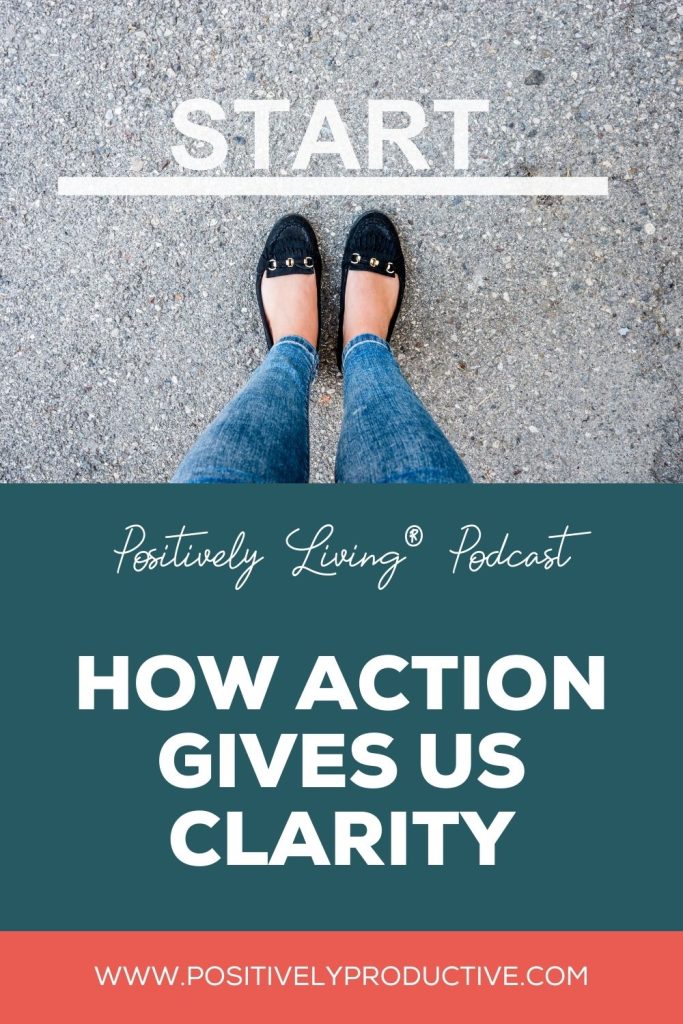
In this episode of the Positively Living® Podcast, we’re pulling an “Uno Reverse card” on your brain. We’ve been taught that clarity must come before action, but the truth is often the opposite: Action is the very thing that creates the clarity you’ve been searching for.
Why Your Brain Gets Stuck
To move forward, we first have to understand why we get stuck in the first place. Analysis paralysis isn’t just a personality quirk; it’s a byproduct of how our brains are wired.
Your brain is constantly balancing two competing priorities:
- The Drive for Progress: The part of you that wants to achieve goals and check things off the list.
- The Desire for Efficiency: The part of you that wants to avoid mistakes, save energy, and stay safe.
When you face a complex decision, these two priorities collide. Your brain wants to move (Progress), but it’s terrified of making a wrong turn (Efficiency/Safety). To resolve this, it starts simulating every possible outcome. This is “thinking about thinking.”
The problem is that your brain is trying to solve a puzzle with missing pieces. When you lack real-world data, your mind stays stuck spinning in hypotheticals. You can’t “think” your way into knowing how a new project will feel or how a customer will respond—you can only know those things by doing.
The Myth of “Clarity First”
Most of us were raised with the idea that we should “look before we leap.” While that is sound advice for jumping off cliffs, it can be paralyzing when applied to business, creativity, or personal growth.
We wait for a “sign,” a “spark,” or a “perfect plan.” We believe that once we have total certainty, the action will be easy. But certainty is a moving target. In reality, the “perfect” plan doesn’t exist until it is tested.
By waiting for clarity to arrive like a lightning bolt, we actually prolong our confusion. We deny our brains the very feedback they need to settle the debate between progress and safety.
Action as a Data Collector
Think of action not as a final commitment, but as a data-gathering mission.
When you take a step—even a small one—you receive immediate feedback.
- Did that email feel right to send?
- Did that first draft reveal a better headline?
- Did that conversation open a door you didn’t know existed?
This feedback is “real-world data.” Once your brain has data, the “Efficiency” side of your mind can relax because it’s no longer guessing. It now has facts to work with. This is how movement reduces the pressure your brain is carrying.
The Smallest Safe Step
If the idea of “taking action” feels overwhelming, it’s likely because you’re looking at the entire mountain instead of the first step. To break analysis paralysis, you need to identify the Smallest Safe Step.
A “Safe Step” is an action that:
- Requires low stakes: If it doesn’t work, the consequences are minimal.
- Is easy to execute: It doesn’t require weeks of preparation.
- Provides immediate feedback: You learn something the moment it’s done.
For example, if you’re stuck on starting a podcast, don’t worry about the 50-episode strategy. Your smallest safe step might be recording a 30-second intro on your phone just to hear how your voice sounds. That tiny action provides the data (and the confidence) to take the next step.
Overcoming the Perfection Trap
Perfectionism is the primary fuel for analysis paralysis. We overthink because we are afraid that any action less than “perfect” is a failure.
However, in the world of productivity and personal growth, momentum is almost always more valuable than perfection. Momentum creates a “snowball effect.” Once you start moving, it becomes easier to keep moving. The friction of starting is always higher than the friction of continuing.
By prioritizing movement over a flawless strategy, you give yourself permission to be a “work in progress.” You realize that a “wrong” step taken quickly is often better than a “right” step that is never taken at all, because the “wrong” step at least tells you which way not to go.
Creating Your Own Clarity
As we often say on the Positively Living® Podcast, clarity is not always something you find. Sometimes, it is something you create.
If you are feeling stuck today, stop looking for the answer in your head. Your head has done enough work for now. It’s time to let your hands, your feet, or your voice take over.
Your Action Plan:
- Identify one area where you have been overthinking.
- Acknowledge the missing data. What are you trying to “guess” that you could actually “test”?
- Take the Smallest Safe Step. Do one thing in the next ten minutes that gives you a tiny bit of real-world feedback.
Need Help Clearing the Noise?
Sometimes, the mental clutter is so loud that you can’t even see the first step. If you need support quieting the mental noise before you take action, I’ve created a tool just for you.
Visit the resources page at positivelyproductive.com/resources to download my Guided Mind Sweep. It’s a simple, effective process designed to help you clear cognitive clutter, get everything out of your head, and regain your mental traction.
In our next episode, we’ll build on this conversation by exploring how journaling—specifically a unique type of journaling you might not expect—can help untangle those thoughts and keep your momentum going.
Until then, be gentle with yourself. Remember that you don’t need all the answers to start. You just need to move.