We live in a culture that glorifies the “grind.” We are told that if we aren’t pushing, we’re falling behind. If we aren’t our own harshest critics, we’ll become lazy. We’ve been conditioned to believe that the voice in our head, the one that scolds us when we miss a deadline, lose track of time, or fall short of a goal, is the very thing keeping us on track.
But what if that harsh inner critic is actually the biggest obstacle standing in the way of your success?
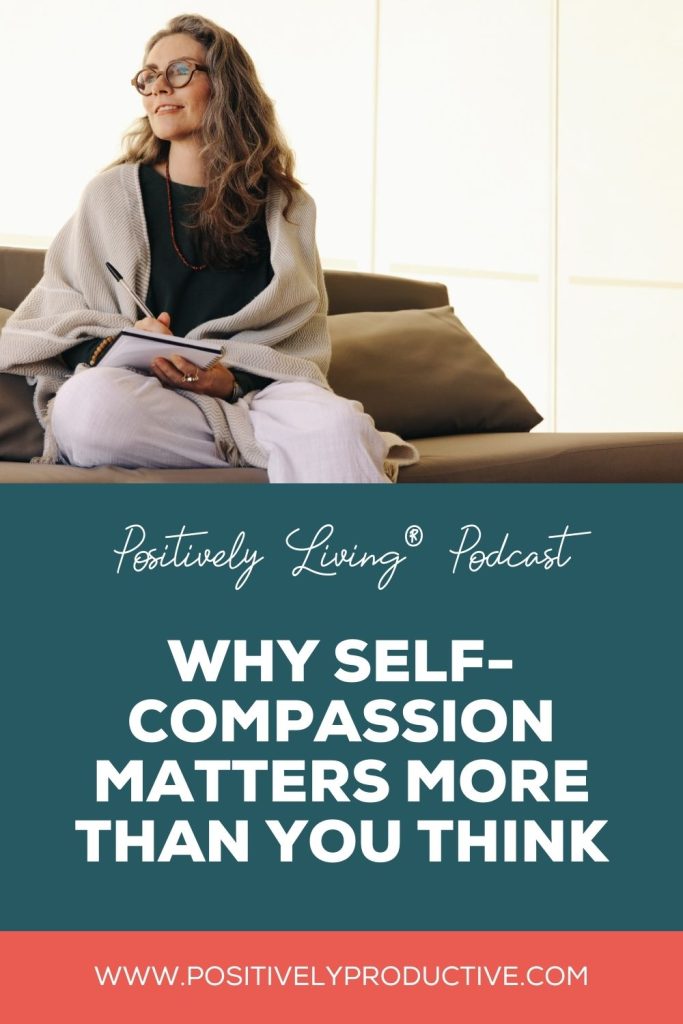
In the latest episode of the Positively Living® Podcast, I explore a concept that is frequently misunderstood and often dismissed as “soft”: self-compassion. Far from being a luxury or a sign of weakness, self-compassion is a biological necessity for anyone seeking sustainable productivity and emotional resilience.
The Myth of the Harsh Inner Critic
Most high achievers operate under a “tough love” policy with themselves. When the door closes and the world isn’t watching, the inner voice turns sharp. You might say things to yourself that you would never dream of saying to a friend, a colleague, or even a stranger.
We tell ourselves that this internal pressure is necessary. We fear that if we are “kind” to ourselves, we will lose our edge. We worry that self-compassion is just a fancy word for making excuses or letting ourselves off the hook.
However, research in positive psychology and neuroscience tells a different story. When you criticize yourself harshly, your brain doesn’t see it as “motivation.” It sees it as a threat. This triggers the part of your brain responsible for the fight-flight-freeze response. Your body floods with cortisol, your muscles tense, and your perspective narrows.
In this state, you aren’t more productive; you are more reactive. You lose the ability to think creatively, solve complex problems, and innovate. By being “tough” on yourself, you are actually sabotaging the very brain functions you need to succeed.
What Self-Compassion Actually Is (And Isn’t)
To understand why this matters, we have to look at what self-compassion actually entails. It isn’t about self-indulgence or toxic positivity. According to leading researchers like Dr. Kristin Neff, self-compassion is built on three essential pillars:
1. Self-Kindness vs. Self-Judgment
Self-kindness means responding to your own struggles with the same warmth and understanding you’d offer someone you care about. It’s the difference between saying, “I’m a failure because I missed this deadline,” and saying, “I’m having a hard time right now; what do I need to get back on track?”
2. Common Humanity vs. Isolation
When we fail, we tend to feel uniquely flawed. We think, “Everyone else has it figured out, but I’m the only one who can’t keep it together.” Common humanity reminds us that suffering, failure, and imperfection are part of the shared human experience. You aren’t “broken”; you are human.
3. Mindfulness vs. Over-Identification
Mindfulness allows us to observe our painful thoughts and feelings without being swept away by them. It’s the ability to notice, “I am feeling a lot of shame right now,” without becoming the shame itself. It creates the space necessary to respond rather than react.
Self-Compassion as a Productivity Tool
In the Positively Living® Podcast, I often talk about how self-awareness is the ultimate productivity tool. But if self-awareness is the tool, self-compassion is the environment in which that tool operates.
Think of it like a laboratory. If a scientist is working in a lab where they are punished for every failed experiment, they will eventually stop experimenting. They will play it safe, hide their mistakes, and eventually burn out. But if the lab environment is one of psychological safety—where mistakes are viewed as data points—innovation flourishes.
Self-compassion provides that psychological safety for your own mind. It allows you to:
- Recover faster: When you don’t spend three hours spiraling into shame after a mistake, you can get back to work in fifteen minutes.
- Take more risks: You are more likely to try something new if you know you won’t be “executed” by your inner critic if it doesn’t work out.
- Maintain higher standards: Contrary to popular belief, self-compassionate people often have higher standards because they aren’t afraid to look at their failures honestly. They can admit when they’ve messed up because their self-worth isn’t on the line.
Moving Toward Sustainable Success
If you have spent decades using self-criticism as your primary motivator, shifting toward self-compassion will feel unnatural. It might even feel “wrong” or “lazy” at first. That is normal.
Self-compassion is a skill, and like any skill, it requires practice. It starts with awareness. This week, I challenge you to simply notice your inner dialogue. You don’t even have to change it yet. Just observe the tone of your voice when you hit a snag in your day.
Ask yourself: Is this voice adding pressure, or is it creating support?
Conclusion: Stop Punishing, Start Performing
Self-compassion isn’t about being nice to yourself when things are going well. Anyone can do that. It’s about how you respond when things are falling apart. It’s about what happens in the moment you realize you’ve lost momentum, missed the plan, or hit your limit.
It doesn’t ask you to lower your standards. It asks you to stop punishing yourself long enough to see clearly and move forward with intention.
If you’re ready to stop the cycle of burnout and start building a life of sustainable, positive productivity, it’s time to give yourself the same grace you so freely give to others.